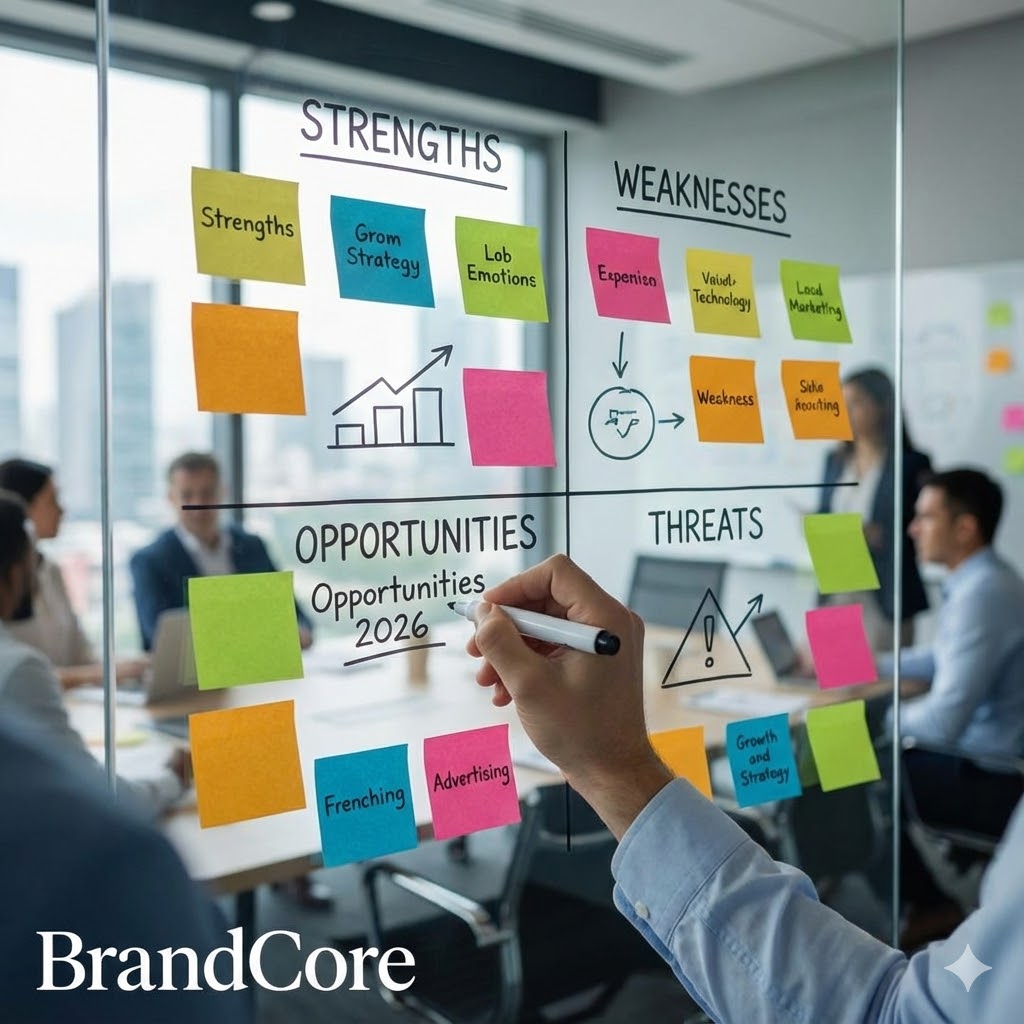
Strategy first, execution second: Mastering SWOT Analysis for your 2026 startup.
Last Updated: December 2025 | By BrandCore Team
In the high-speed world of startups, passion is fuel, but strategy is the engine. Many founders rush to build a product without checking if the road ahead is clear. This is why 20% of small businesses fail in their first year [Source: Bureau of Labor Statistics].
To avoid becoming a statistic, you need a compass. That compass is the SWOT Analysis. It is a simple yet powerful framework that forces you to look at your business from four critical angles: Strengths, Weaknesses, Opportunities, and Threats.
In this ultimate guide for 2026, we will move beyond the textbook definitions. We will show you how to conduct a “Modern SWOT” that accounts for AI, remote work, and the new digital economy.
Strategic Tip: One of your biggest strengths should be your brand. Is your name catchy? Test it now with our Free Business Name Generator.
What is SWOT Analysis? (The 2026 Edition)
SWOT stands for Strengths, Weaknesses, Opportunities, and Threats. It is divided into two dimensions:
- Internal Factors (You control these): Strengths & Weaknesses.
- External Factors (You can’t control these): Opportunities & Threats.
S: Strengths (Internal & Positive)
These are your superpowers. What do you do better than anyone else? In 2026, strengths aren’t just “we have a good product.” They are about leverage.
Questions to Ask:
- Do we have proprietary technology (IP)?
- Is our brand name sticky and memorable?
- Do we have exclusive partnerships or supply chains?
- Is our team leaner and faster than the competition?
Example:
“Our startup uses an AI-driven customer service bot that reduces response time to 2 seconds, while competitors take 24 hours.”
W: Weaknesses (Internal & Negative)
Be honest. Brutally honest. If you hide your weaknesses now, the market will expose them later.
Questions to Ask:
- Do we lack funding compared to incumbents?
- Is our team inexperienced in this specific niche?
- Is our website traffic low?
- Are our profit margins too thin?
Example:
“We rely heavily on a single supplier in China. If shipping routes are disrupted, we have zero inventory.”
O: Opportunities (External & Positive)
These are the waves you can surf. You don’t create them, but you can capitalize on them.
Trends to Watch in 2026:
- Regulatory Changes: Is the government offering grants for Green Tech?
- Consumer Behavior: Are people shifting to remote work permanently?
- Technology: Can we use the new GPT-6 API to automate our backend?
Example:
“Competitor X just raised their prices by 20%. This creates an opportunity for us to capture their budget-conscious customers.”
T: Threats (External & Negative)
These are the storms on the horizon. Ignoring them won’t make them go away.
Common Threats for Startups:
- New Entrants: Is it easy for someone else to copy your idea?
- Economic Downturn: Will people stop buying your luxury product if a recession hits?
- Platform Risk: What if Google changes its SEO algorithm or Apple changes privacy rules?
Example:
“A massive tech giant (like Amazon) is rumored to be entering our niche next year.”
Putting It All Together: The “TOWS” Matrix
Most people stop at listing points. Experts use the TOWS Matrix to create strategy. This involves matching the quadrants:
Maxi-Maxi Strategy (S-O)
How can you use your Strengths to maximize Opportunities?
Strategy: “Use our strong AI tech (S) to launch a new product for the growing remote work market (O).”
Mini-Mini Strategy (W-T)
How can you minimize Weaknesses to avoid Threats?
Strategy: “Secure a backup supplier locally (fixing W) to avoid the threat of global shipping delays (T).”
Real-Life Example: “JavaGenius” (Hypothetical AI Coffee Shop)
Let’s apply this to a fictional startup launching in 2026.
- Strengths: Low overhead (robotic baristas), 24/7 operation app.
- Weaknesses: No human connection, brand is unknown.
- Opportunities: Urban centers are becoming 24-hour cities; Gen Z prefers contactless ordering.
- Threats: Starbucks launching their own automated kiosks; rising coffee bean prices.
The Verdict: JavaGenius should focus aggressively on the “Gen Z / Night Owl” niche where Starbucks is weak, turning their 24/7 operation into a key differentiator.
Frequently Asked Questions (FAQ)
How often should I do a SWOT analysis?
At least once a year. However, if you are a fast-moving startup, you should revisit it quarterly or whenever a major market shift happens (like a new AI breakthrough).
Can SWOT help with personal branding?
Absolutely. You can perform a “Personal SWOT” to analyze your career. What are your skills (S)? What skills do you lack (W)? Where is the job market going (O)?
What comes after SWOT?
Action. A SWOT analysis is useless if it sits in a drawer. Use it to build your Business Plan and set your OKRs (Objectives and Key Results).
Conclusion: Turn Insight into Action
A SWOT analysis gives you the clarity to say “No” to bad ideas and “Yes” to the right ones. In 2026, the winners won’t be the ones with the most money, but the ones with the clearest map.
Map out your future. But first, give your future a name.
Start your journey here:
👉 Launch Your Business Name Generator


